Read every application. Explain every score.
Applications arrive by email. Staffly ATS+ reads every resume, scores each candidate 0–100 against the criteria you set for that role, and shows you the reasoning behind every point.
- Starts with a forwarding rule
- No mailbox access required
- PDFs, Word files and scanned CVs
- Unlimited seats on every plan
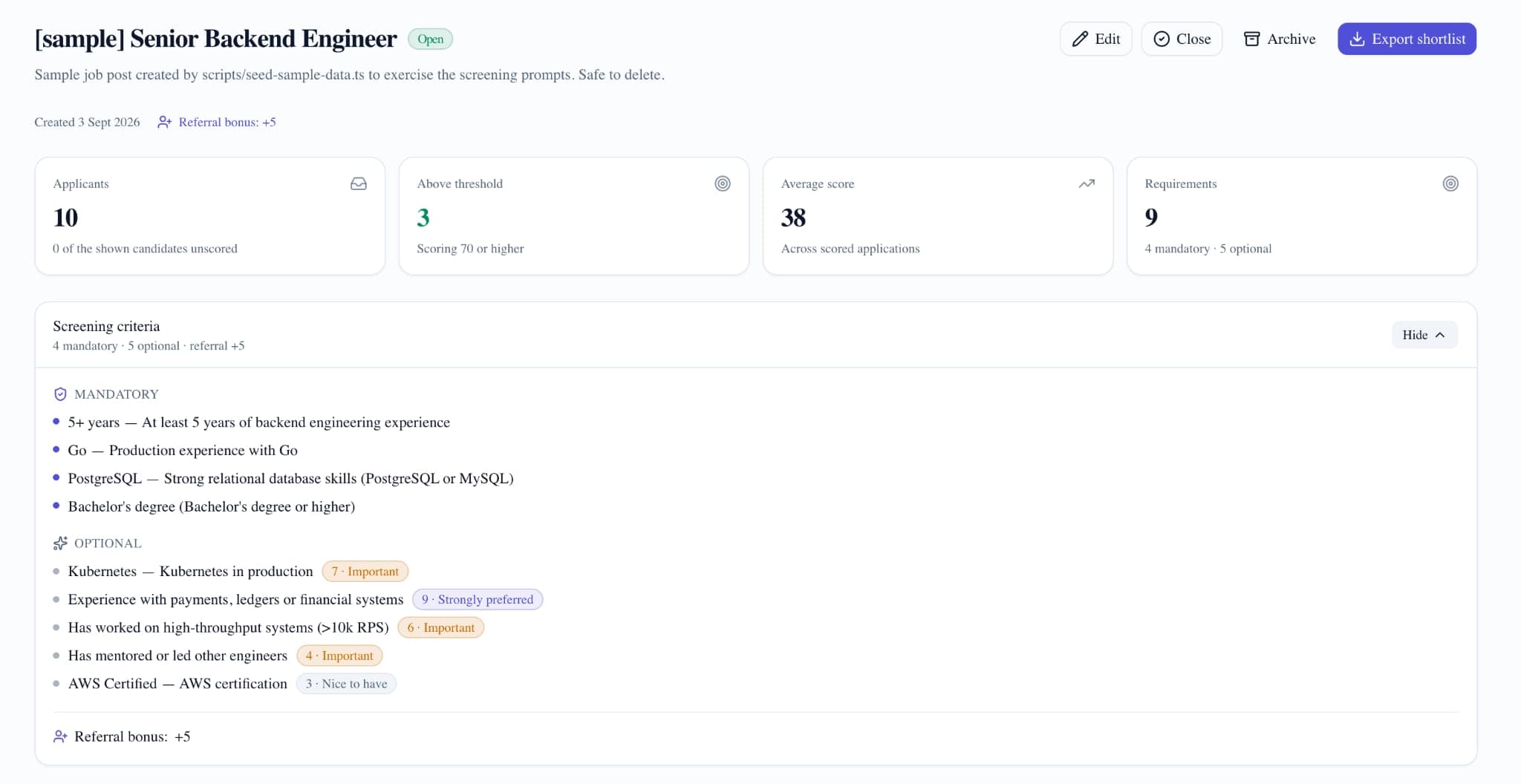
Hundreds of applications. One afternoon to read them.
A single job post can draw hundreds of applications. Recruiters skim, get tired, and good candidates fall through. Generic AI screeners hand back a number nobody can explain, which is worse. You can't defend it to a hiring manager, or to a candidate who asks why.
Four steps, and the first one is a forwarding rule.
Nothing changes for your candidates, and nothing changes about where they apply.
- Step 01
Forward your applications.
Your organization gets a private email alias. Point your careers inbox at it with a forwarding rule. No mailbox OAuth, no integration project, no change to where candidates apply.
- Step 02
Every resume gets read.
PDFs, Word documents, even scanned CVs. The agent reads them visually when there is no text layer, and extracts skills, work history with dates, education, certifications and contact details into structured fields.
- Step 03
Every candidate gets scored.
You define what the role requires: must-haves as a hard gate, nice-to-haves with weights. The agent judges each requirement on its own and writes a sentence of evidence for it.
- Step 04
You review a ranked shortlist.
Filter by score, university, nationality, referral or review flags. Open any candidate to see the full breakdown: which requirements they met, which they missed, and why.
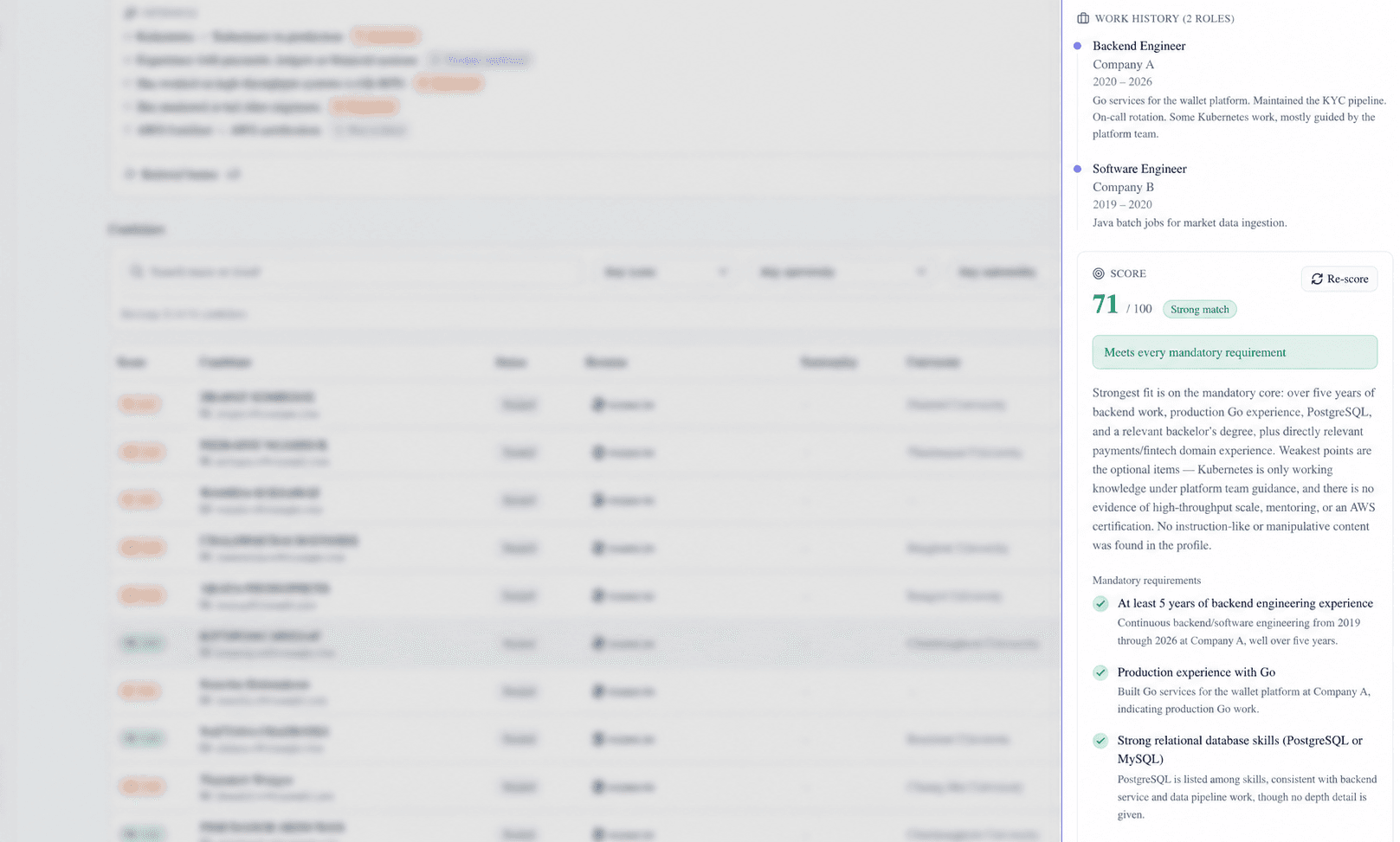
A score you can put in front of a hiring manager.
Every number on this page traces back to a requirement you wrote and a sentence of evidence the agent found in the resume.
Explainable by construction
The AI decides met or not met and writes the rationale. The score itself is computed by deterministic code from those verdicts. The model never sees the formula and is never asked for a number.
So a score reads like this, rather than “the AI said 78.”
- Must-have requirements
- 4 of 4 met, gate passed
- Preferred requirements
- 3 of 4 met, at weights 7, 4 and 3
- Referral bonus
- +5
It never invents
If a resume does not state something, the field comes back empty. Nationality is recorded only when it is written outright, never guessed from a name, a language, a location or a phone number.
Built for fairness
Candidates are judged only against the requirements you wrote. Protected characteristics are excluded from the evaluation, and the scoring agent is never shown the candidate's nationality at all.
Hardened against manipulation
A resume is a document a stranger emailed you, and it can carry hidden text aimed at the AI. Staffly treats every resume as untrusted input, and the scoring step reads structured fields rather than raw document text. A candidate can't talk their way into a 95.
It flags what needs a human
A candidate who misses one hard requirement out of four. A borderline score that only cleared the bar because of a referral. Anything the model couldn't judge. These surface for review instead of being rejected quietly.
Isolated by tenant
Every organization's data is separated at the database level. Resumes live in private storage behind short-lived signed links, and candidate files are deleted with the account.
The rest of the day-to-day.
- Criteria builder with weighted requirements
- Unassigned-resume inbox with one-click routing to a role
- Candidate detail view with a work-history timeline
- Server-side filtering that stays fast at high volume
- Email digests when a resume fails to process, so a dropped application never goes unnoticed
- Team roster with roles
- Preferred-university and referral prioritization
- Unlimited seats, so the whole team can review without adding to the bill
Priced by applications, not by seat.
Applications pool annually, so a hiring surge in one month costs no more than the same volume spread across the year. Every plan includes unlimited seats, so adding a recruiter never changes the bill.
Annual billing saves roughly 17%.
Shortlist
For a small team hiring a few roles at a time.
$79/ month
- 1,800
- applications / year included
- $0.70
- per extra application
- 3
- job posts
- 1
- inbox
- Unlimited
- seats, at no extra cost
Pipeline
For agencies and in-house teams hiring continuously.
$250/ month
- 10,800
- applications / year included
- $0.50
- per extra application
- 15
- job posts
- 2
- inboxes
- Unlimited
- seats, at no extra cost
Talent Pool
For high-volume hiring across many open roles.
$499/ month
- 30,000
- applications / year included
- $0.35
- per extra application
- Unlimited
- job posts
- 5
- inboxes
- Unlimited
- seats, at no extra cost
Enterprise
Custom volume, custom terms, and a contract your procurement team can sign.
Custom
- Everything in Talent Pool
- Volume pricing above 30,000 applications
- Security review and custom terms
- Unlimited seats, as on every plan
What a production agent looks like when the decision has to be defensible.
Claude Opus 5, pinned to an exact version, so screening behavior never drifts under customers without a deploy.
Durable step-based workflows. Every stage retries on its own, so a transient failure never loses an application.
A deterministic scoring engine wrapped around a non-deterministic model.
Postgres with row-level tenant isolation, Next.js 15, and usage-metered billing.
Before you ask.
What happens to our candidate data?
Each organization's records are separated at the database level, so no other tenant can reach them. Resumes are held in private storage and are only ever served through short-lived signed links. When you close your account, candidate files are deleted with it.
Does this replace a recruiter?
No. Staffly reads and ranks so you can spend your time on the people worth a conversation. Every score comes with the evidence behind it, and anything borderline is flagged for a human rather than rejected quietly. The hiring decision stays yours.
What file types does it handle?
PDFs and Word documents, including scanned CVs with no text layer. Those are read visually rather than parsed as text, so a photographed or scanned resume is still extracted and scored.
Can a candidate manipulate their score?
Resumes are treated as untrusted input, so hidden instructions aimed at the AI are not followed. The scoring step reads the structured fields extracted from the resume rather than the raw document text, which leaves nothing for a candidate to write into.
How does it connect to the way we hire today?
You add a forwarding rule to your careers inbox pointing at the private alias we give you. There is no mailbox OAuth and no integration project, and candidates keep applying exactly where they do now.
How is nationality handled?
Nationality is recorded only when a resume states it outright, and it is never inferred from a name, a language, a location or a phone number. The scoring agent is never shown it. It exists as a filter for your own review, not as an input to the score.
Do we pay per recruiter?
No. Seats are unlimited on every plan, so you can invite your whole team, including hiring managers who only need to look at a shortlist. Billing is based on the number of applications screened, not on how many people log in.
Put your next job post through it.
Staffly ATS+ is in private beta. Tell us what you hire for and we will be in touch.